
SCAPULO HUMERAL RHYTHM
1.Introduction
Scapulohumeral rhythm is the coordinated movement between the glenohumeral (GH) joint and the scapulothoracic (ST) articulation during elevation of the arm.
When we raise our arm, the humerus moves at the shoulder joint and the scapula also rotates upward. Both movements occur together to produce smooth and complete shoulder movement.
2.Normal Scapulohumeral Rhythm
The normal scapulohumeral rhythm is approximately 2:1.
It means that for every 3° of shoulder elevation:
2° of movement occurs at the glenohumeral joint.
1° of movement occurs due to scapular upward rotation.
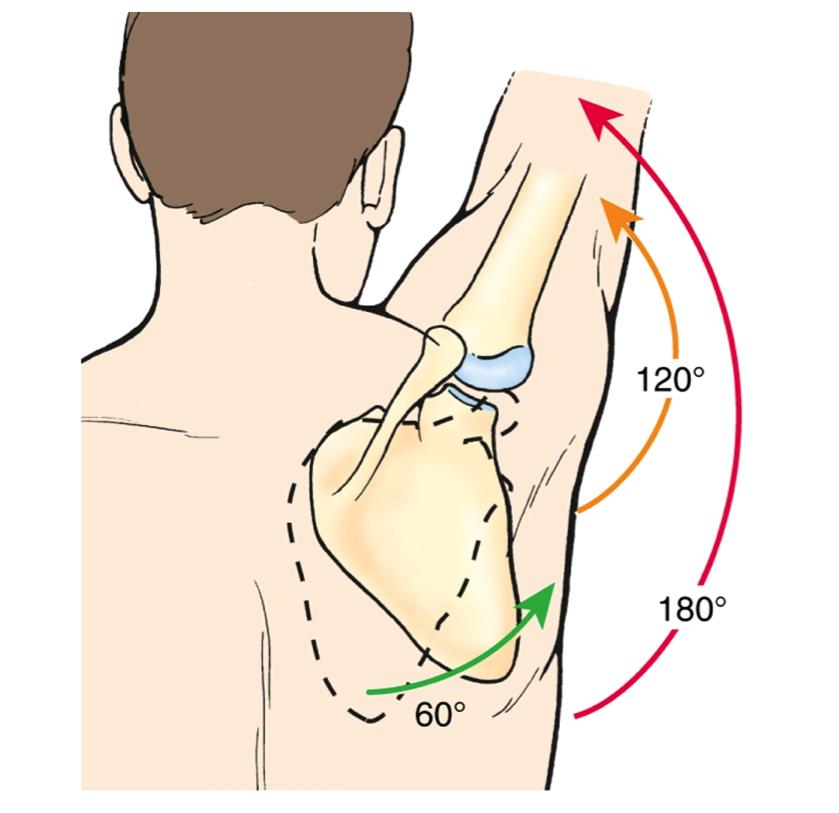
Example:
When the arm is raised to 180° during shoulder abduction:
Joint Movement
Glenohumeral joint 120°
Scapulothoracic articulation 60°
Total 180°
Therefore, the total shoulder movement is 180°.
3. Phases of Scapulohumeral Rhythm
Scapulohumeral rhythm is traditionally divided into three phases.
Phase I – Setting Phase (0°–30°)
This is the initial stage of shoulder abduction.
During this phase, the scapula starts adjusting its position.
Slight scapular movement occurs.
There is no fixed 2:1 ratio during this phase.
Phase II – Established Rhythm (30°–90°)
During this phase, the humerus and scapula move together in a coordinated manner.
The humerus moves upward at the glenohumeral joint.
The scapula rotates upward.
Approximately 2:1 ratio is maintained.
For 60° of total movement in this phase (approximately):
GH joint = 40°.
Scapula = 20°
Phase III – Continued Elevation (90°–180°)
During this phase, the arm continues to move above shoulder level.
The scapula continues upward rotation.
The glenohumeral joint also contributes to the movement.
Both movements help to achieve full shoulder elevation.
4. Movements Occurring During Scapulohumeral Rhythm
During shoulder abduction, the following movements occur:
In Glenohumeral joint-
*Abduction of the humerus.
*Superior movement of the humeral head relative to the glenoid is controlled by the rotator cuff.
*The humeral head remains appropriately centred in the glenoid cavity.
In Scapulothoracic articulation-
*The scapula performs three important movements:
*Upward rotation: The glenoid cavity turns upward to support arm elevation.
*Posterior tilt: The upper part of the scapula tilts backward.
*External rotation: The scapula rotates externally around the thoracic wall.
5. Muscles Responsible for Scapulohumeral Rhythm
Muscles and their Functions
Supraspinatus- Initiates abduction and assists throughout elevation
Middle deltoid - Major contributor to shoulder abduction
Anterior deltoid- Assists shoulder flexion and abduction
Posterior deltoid- Assists abduction and extension
6. Muscles responsible for scapular upward rotation
Muscles and their Functions
Upper trapezius- Elevates and assists upward rotation of scapula
Lower trapezius- Depresses and assists upward rotation of scapula
Serratus anterior- Protracts and rotates scapula upward; maintains scapular contact with thoracic wall
Functions of Scapulohumeral Rhythm
1. Increases range of motion: Allows the arm to achieve approximately 180° of elevation.
2. Maintains joint stability: Helps maintain appropriate alignment between the humeral head and glenoid cavity.
3. Prevents impingement: Scapular upward rotation and posterior tilt help maintain subacromial clearance during arm elevation.
4. Maintains muscle length: Provides an appropriate length-tension relationship for shoulder muscles.
5. Improves functional activities: Helps perform activities such as combing hair, reaching overhead, dressing and lifting objects.
6. Distributes movement: Shares the movement between the glenohumeral joint and scapulothoracic articulation rather than relying entirely on the glenohumeral joint.
7. Maintains scapular stability: Serratus anterior and trapezius muscles maintain proper scapular positioning during arm movements.
Clinical Anatomy
1. Scapular dyskinesis
Scapular dyskinesis refers to abnormal scapular movement or positioning during shoulder movements.
Possible findings include:
Excessive scapular elevation.
Reduced upward rotation.
Abnormal scapular winging.
Altered scapular posterior tilt
2.Shoulder impingement syndrome
Reduced scapular upward rotation or posterior tilt may contribute to reduced subacromial clearance.
This may increase compression of structures beneath the acromion during arm elevation.
3.Rotator cuff disorders
Abnormal scapular mechanics may alter the loading and function of the rotator cuff.
It can contribute to shoulder pain and reduced functional performance.
Physiotherapy Management
* Strengthening exercises
* Scapular stabilization exercises
*Range of motion exercises
* Neuromuscular control
* Postural correction
- Teacher: Anbuselvi P